
Recently, the Engineering Company under CNEPG successfully passed the scientific and technological achievement evaluation organized by the China Association of Urban Environmental Sanitation for its self-developed AI Smart Combustion System V1.0, which was recognized as a domestically leading technological achievement. The system has now been officially commercialized and, through advanced intelligent control technologies, addresses multiple pain points in the waste incineration industry, helping waste-to-energy plants reduce costs, improve efficiency and advance intelligent operations.
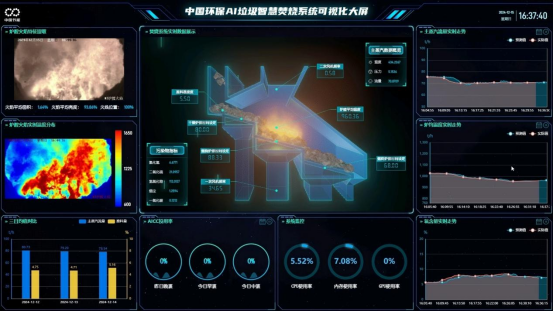
Visual dashboard of the AI Smart Waste Incineration System
It is reported that municipal solid waste in China generally features complex compositions, fluctuating calorific values and high moisture content. At present, most waste incineration plants still rely on a control model combining operator experience and traditional Distributed Control Systems (DCS), which often leads to unstable furnace conditions, fluctuating steam output, high energy consumption and challenges in flue gas management, thereby constraining the industry's high-quality development. To address these challenges, the Engineering Company developed an innovative smart combustion system built on a dual technological foundation of mechanism-based models and deep time-series data-driven technologies, breaking through the limitations of conventional control systems and reshaping the management and control model across the entire waste incineration process.
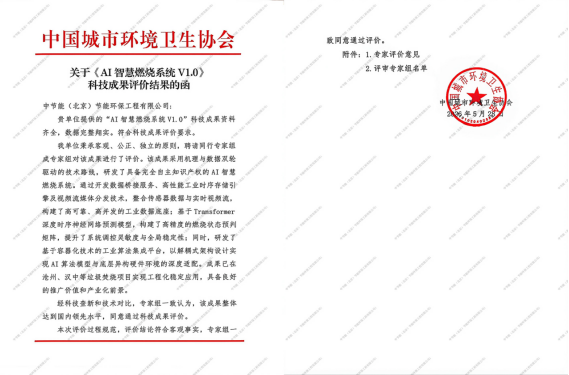
AI Smart Combustion System V1.0 passes the scientific and technological achievement evaluation by the China Association of Urban Environmental Sanitation
Leveraging a cloud-native microservices architecture, the system establishes a fully closed-loop automated control framework encompassing data sensing, edge prediction, intelligent decision-making and equipment execution. It integrates underlying DCS data, covers more than 300 sensor points across 12 major categories, and combines high-definition furnace flame video monitoring to achieve dual monitoring through both data and visual analysis. At the core algorithm level, the system utilizes deep neural networks to predict operating-condition fluctuations up to five minutes in advance, with a prediction error of less than 5% and an algorithm response time of no more than 200 milliseconds, enabling a shift from passive corrective control to proactive predictive control. In addition, the system adopts a multi-algorithm integrated control approach and containerized deployment technology, balancing operational stability with cost-effective implementation.
The system has already been successfully deployed at two waste incineration projects with treatment capacities of 800 tons per day in Cangzhou and 600 tons per day in Hanzhong. On-site performance data show that the automation utilization rate of key equipment exceeds 95%, significantly reducing dependence on manual operations. The stability of main steam flow has improved by more than 30%, substantially enhancing power generation efficiency. Fluctuations in key process parameters have been effectively reduced, while the consumption of consumables and environmental protection chemicals has declined. Flue gas emissions remain consistently compliant with regulatory requirements, delivering remarkable overall results in cost reduction and efficiency improvement.
As a standardized and replicable industrial AI automation solution, the product is adaptable to solid waste incineration projects operating under different conditions across various regions. Going forward, the company will continue to upgrade and refine the system, develop a plant-wide intelligent management platform, and expand its business footprint by applying its proven AI control model to process industries such as chemicals, metallurgy and power generation, supporting intelligent transformation and upgrading across multiple sectors.


