
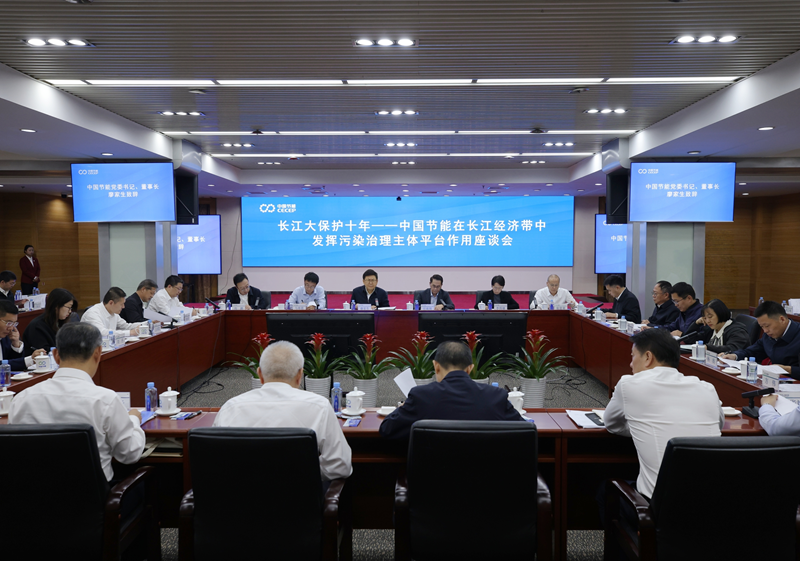
On the afternoon of October 12, CECEP held a symposium titled “A Decade of Yangtze River Protection: CECEP’s Role as a Key Platform for Pollution Control in the Yangtze River Economic Belt”. The symposium aimed to study and implement General Secretary Xi Jinping’s important speeches, instructions and directives on promoting the development of the Yangtze River Economic Belt, systematically review CECEP’s achievements and practical experience as a key platform for pollution control in the region, and discuss ways to further strengthen this role and advance the Group’s contribution to Yangtze River protection. Liao Jiasheng, chairman of CECEP, delivered opening remarks. Zhang Shirong, general manager, chaired the meeting, while Cao Huabin, deputy general manager, presented a work report. Officials from relevant departments and agencies of the National Development and Reform Commission, the Ministry of Ecology and Environment, and the State-owned Assets Supervision and Administration Commission of the State Council attended, along with officials from the development and reform commissions of provinces and cities along the upper, middle and lower reaches of the Yangtze River, as well as academicians and experts.
The meeting noted that since 2016, General Secretary Xi Jinping has chaired four symposiums on the development of the Yangtze River Economic Belt, delivering a series of important speeches and issuing important instructions and directives that have provided fundamental guidance for protecting the Yangtze River. As a key platform for pollution control in the Yangtze River Economic Belt, CECEP has remained mindful of the country’s broader strategic priorities, strengthened its foundations and tackled major challenges, progressing from addressing pollution at individual sites and remedying shortcomings to more comprehensive and sophisticated approaches. CECEP has pursued integrated treatment and ecological restoration by coordinating various ecological elements, including mines, riverbanks, rivers and lakes, and wetlands. It has promoted a shift toward integrated conservation and restoration of mountains, rivers, forests, farmlands, lakes, grasslands and deserts, and participated extensively in several national-level integrated ecological conservation and restoration projects along the Yangtze River, establishing exemplary models of comprehensive treatment that can be replicated and promoted elsewhere. The Group has also advanced green development by exploring ways to realize the value of ecological products, developing a systematic methodology encompassing accounting standards, value of ecosystem products (VEP) assessment and green finance applications. Guided by scientific and technological innovation, it has implemented major research projects addressing the needs of Yangtze River governance and developed the Yangtze Cloud big data platform to support coordinated carbon reduction, pollution control, ecological improvement and economic growth across the Yangtze River Economic Belt. By leveraging its role as a platform, CECEP has strengthened collaboration and joint governance, deepening cooperation between central and local authorities through pilot projects and facilitating closer engagement among industry, academia, research institutions and green finance stakeholders to build a framework for the joint protection and shared benefits of the Yangtze River.
The meeting observed that ecological and environmental protection and high-quality development in the Yangtze River basin have reached a critical stage in which incremental progress must give way to qualitative transformation. Further improvements are needed in the depth and precision of integrated governance. Breakthroughs in key technologies and the commercialization of research results remain constrained by dual bottlenecks, sustainable long-term business models require further exploration, and coordination mechanisms involving diverse stakeholders need improvement. Addressing these deep-rooted, structural challenges will require collective efforts and sustained commitment from all parties.
The meeting emphasized that, at the start of a new decade of Yangtze River protection, CECEP will further implement General Secretary Xi Jinping’s important speeches, instructions and directives on developing the Yangtze River Economic Belt and fully carry out the requirements set by the National Development and Reform Commission, the Ministry of Ecology and Environment, the State-owned Assets Supervision and Administration Commission of the State Council and other government bodies. The Group will firmly assume its responsibilities as a key platform for pollution control and continue to deepen exchanges and cooperation with local governments and all sectors of society along the Yangtze River. CECEP will strengthen strategic coordination by integrating Yangtze River protection more deeply into the Group’s 15th Five-Year Plan (2026–2030), ensuring consistent implementation of its long-term vision. It will intensify efforts to tackle pollution, focusing on key tasks under the Three-Year Action Plan for Yangtze River Protection and continuing to improve the basin’s ecological and environmental quality. It will adhere to integrated governance and actively participate in major Yangtze River conservation and restoration initiatives, providing local governments along the river with comprehensive, end-to-end solutions. The Group will also strengthen innovation by concentrating resources on breakthroughs in key technologies, including the resource utilization of phosphogypsum, the control of emerging pollutants and the management of water-level fluctuation zones, while accelerating upgrades to big data platforms such as Yangtze Cloud. In addition, CECEP will advance green and low-carbon development by expanding wind and solar power projects along the Yangtze River and continuing to explore ways to realize the value of ecological products. It will further leverage its platform role by improving regular coordination mechanisms between central and local authorities, mobilizing more private and other social capital for Yangtze River protection, and helping establish a framework for coordinated, multi-stakeholder governance.
During the first session, officials from relevant central government departments, academicians and experts, and representatives from the development and reform commissions of Anhui, Hubei and Yunnan provinces and Xianning City exchanged views on integrated conservation and restoration of the Yangtze River, innovative financing and investment models for pollution control, mechanisms for realizing the value of ecological products, and the development of the environmental protection industry chain. Participants also watched a video showcasing CECEP’s achievements in Yangtze River protection. During the second session, representatives from several of CECEP’s key subsidiaries shared their experiences and practices.
The symposium was held in a hybrid format, with both in-person and online participation. Attendees included members of CECEP’s leadership team, directors, senior executives, principal officials of its second-tier subsidiaries and those responsible for Yangtze River protection, principal officials and relevant personnel from its third-tier subsidiaries, and heads of departments at the Group’s headquarters and above.


